
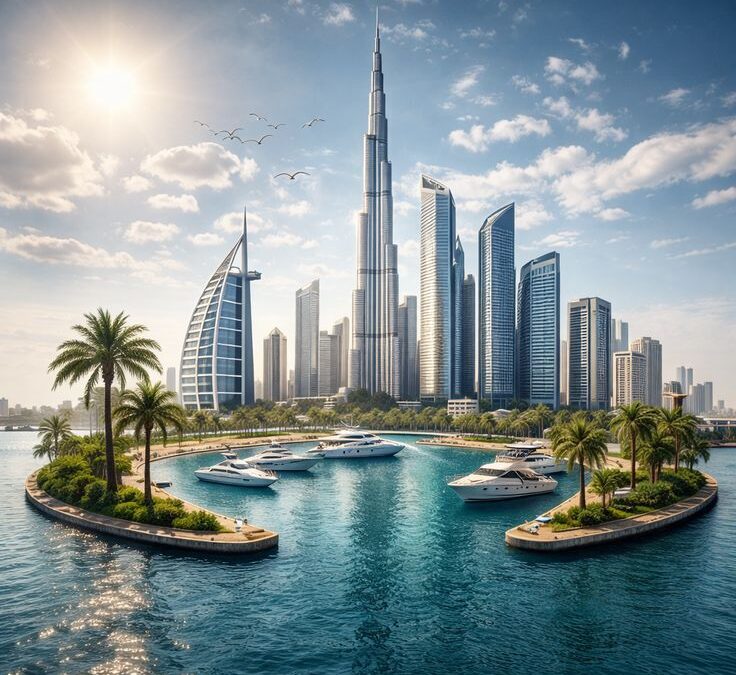
Dubai Maritime City (DMC) is rapidly redefining what smart real estate investment looks like in Dubai. Once known primarily as a global maritime and logistics hub, the district has evolved into a high-performing mixed-use waterfront destination where residential luxury, commercial infrastructure, and industrial strength coexist. This transformation has placed Dubai Maritime City firmly on the radar of investors seeking sustainable returns, long-term growth, and strategic asset positioning.
Backed by accelerated infrastructure development, free zone incentives, and strong market fundamentals, DMC is no longer an emerging location—it is an investment region in transition toward maturity.
A Strategically Engineered Waterfront Location
Dubai Maritime City occupies one of the most purposeful waterfront locations in the emirate. Positioned between Port Rashid and Dubai Drydocks, the district sits at the crossroads of international shipping lanes and Dubai’s urban core. With direct access to the D92 corridor, Jumeirah Beach Road just minutes away, and Sheikh Zayed Road within close reach, DMC ensures seamless connectivity for residents, professionals, and businesses.
For investors, this strategic placement delivers a critical advantage: continuous demand driven by trade, logistics, and executive housing requirements rather than lifestyle trends alone.
Also Read: Dubai Real Estate Market Reaches Record Dh917 Billion in 2025: What It Means for Investors?
Free Zone Advantages That Strengthen Investment Returns
As a dedicated free zone, Dubai Maritime City offers 100% foreign ownership, zero corporate and personal income tax, and duty-free import and export benefits.
These incentives attract global companies, maritime operators, and international professionals, creating a deep and reliable tenant base.
From an investment perspective, the free zone structure improves net yields, reduces operational friction, and enhances long-term profitability across both residential and commercial assets.
Market Performance That Signals Smart Capital Flow
Dubai Maritime City’s real estate performance highlights why it is increasingly viewed as a smart investment region. Between January 2025 and January 2026, property values surged by over 50%, while transaction volumes rose by more than 52%, with approximately 4,400 sales recorded. Average price per square foot climbed by 22%, and rental yields now average around 5.3%, outperforming several established waterfront communities.
These indicators reflect a market still capturing upside, particularly attractive for early and off-plan investors.
Property Diversity That Supports Multiple Investment Strategies
Unlike single-use districts, DMC offers a broad spectrum of property options. Compact studios and one-bedroom apartments appeal to rental-focused investors, while premium waterfront residences and penthouses cater to high-net-worth buyers. Commercial offices, showrooms, and industrial plots further expand opportunities, allowing investors to diversify within one integrated district.
Competitive Entry Prices in a Premium Waterfront Market
Despite its strategic positioning and luxury appeal, Dubai Maritime City remains more competitively priced than established waterfront destinations such as Palm Jumeirah and Dubai Marina. This pricing gap presents a strong value proposition for investors aiming to enter a premium market before full price discovery and project handovers are completed.
Also Read: Maximize Your ROI: Insider Secrets to Dubai’s Most Promising Real Estate Opportunities
A Fully Integrated Mixed-Use Ecosystem
Dubai Maritime City is designed as a self-sustaining urban environment. Its master plan includes a Marina District, Harbour Residences, a Maritime Business Center, an Academic Quarter, and an Industrial Precinct. This balanced ecosystem ensures continuous activity, strong occupancy levels, and resilience during broader market cycles.
Long-Term Vision Supported by Government Strategy
Aligned with Dubai’s 2040 Urban Master Plan, Dubai Maritime City benefits from sustained infrastructure investment, sustainability-driven development standards, and major connectivity upgrades such as the Al Shindagha Corridor Project. Property investors meeting qualifying thresholds can also access long-term UAE residency, enhancing asset security and global appeal.
Conclusion
Dubai Maritime City is emerging as one of Dubai’s smartest real estate investment regions because it delivers more than lifestyle-driven demand. Its strategic location, free zone advantages, diversified property mix, competitive pricing, and strong maritime-backed economy create a resilient, future-focused investment environment.
For investors seeking capital appreciation, stable rental income, and long-term relevance, Dubai Maritime City represents a calculated, high-conviction investment within Dubai’s evolving real estate landscape.